
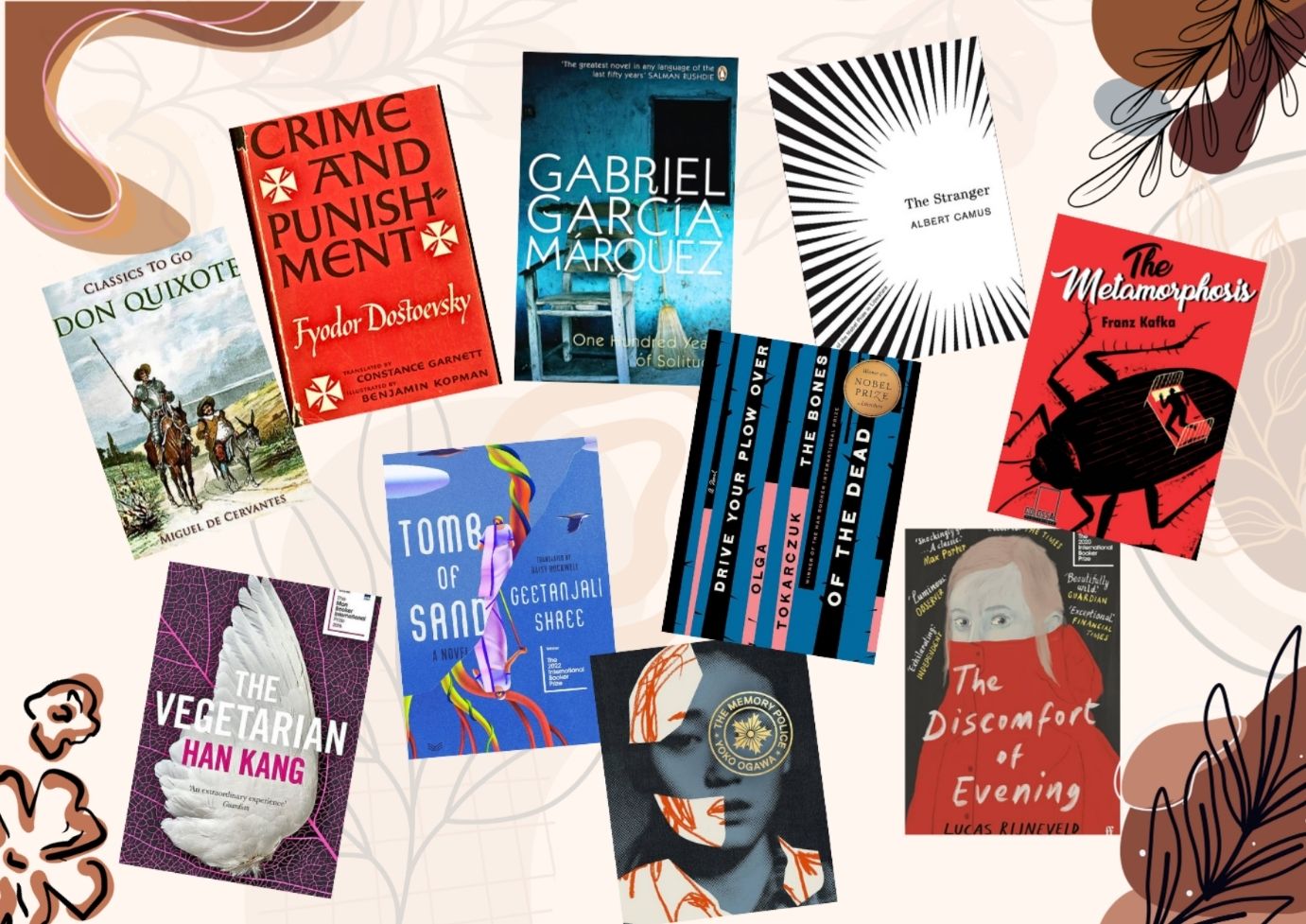
10 Must-Read Translated Books from Around the World
Literature can take us beyond the boundaries of our own experiences. Through translated books, we can explore unfamiliar cultures, understand different histories, and encounter ideas that challenge the way we see the world. From timeless European classics to award-winning contemporary fiction, these ten books take us on a journey across languages, continents, and generations.
1. Don Quixote by Miguel de Cervantes
Translated from Spanish
Often regarded as one of the foundations of the modern novel, Don Quixote follows an eccentric gentleman who sets out to revive chivalry, accompanied by his practical squire, Sancho Panza. Blending comedy, adventure, and social commentary, Cervantes’s masterpiece explores the tension between imagination and reality, making it as thought-provoking today as it was centuries ago.
2. Crime and Punishment by Fyodor Dostoevsky
Translated from Russian
What happens when a person believes himself to be above ordinary morality? In this psychological classic, impoverished student Rodion Raskolnikov commits a murder and struggles with the guilt, fear, and consequences that follow. Dostoevsky examines conscience, justice, isolation, and redemption in a gripping exploration of the human mind.
3. One Hundred Years of Solitude by Gabriel García Márquez
Translated from Spanish
Spanning several generations of the Buendía family, this landmark of magical realism tells the story of Macondo, a fictional town shaped by love, political upheaval, extraordinary events, and recurring patterns of history. García Márquez seamlessly blends the mythical with the everyday, creating a richly layered portrait of family, memory, and the passage of time.
4. The Stranger by Albert Camus
Translated from French
First published in 1942, The Stranger follows Meursault, a man whose emotional detachment places him at odds with society’s expectations. Through his actions and the trial that follows, Camus explores absurdism, morality, and the search for meaning in an indifferent universe. Its spare prose and unsettling questions make it an enduring work of philosophical fiction.
5. The Metamorphosis by Franz Kafka
Translated from German
One morning, travelling salesman Gregor Samsa wakes up to discover that he has transformed into a monstrous insect, turning his ordinary life into a nightmare. As his family struggles to cope with his condition, Kafka explores alienation, identity, family obligations, and the dehumanising effects of work. Strange, unsettling, and rich in symbolism, The Metamorphosis remains one of the most influential works of modern literature.
- The Vegetarian by Han Kang
Translated from Korean
Winner of the International Booker Prize in 2016, The Vegetarian begins when Yeong-hye decides to stop eating meat, setting off a series of increasingly disturbing consequences within her family. Through three interconnected perspectives, Han Kang examines bodily autonomy, repression, violence, and the limits of social conformity. Unsettling and unconventional, this novel challenges readers to reconsider the relationship between the individual and society.
7. Tomb of Sand by Geetanjali Shree
Translated from Hindi
Translated into English by Daisy Rockwell, Tomb of Sand became the first novel originally written in an Indian language to win the International Booker Prize in 2022. The story follows an eighty-year-old woman who confronts her past and eventually travels to Pakistan, revisiting the wounds and divisions left by Partition. Playful, experimental, and deeply moving, the novel explores ageing, identity, gender, and the possibility of living beyond society’s expectations.
8. Drive Your Plow Over the Bones of the Dead by Olga Tokarczuk
Translated from Polish
In a remote Polish village, Janina Duszejko, an eccentric woman with a deep interest in astrology and animal rights, becomes involved in a series of mysterious deaths. Blending crime fiction, dark humour, and philosophical reflection, Tokarczuk questions humanity’s relationship with nature and the moral boundaries between justice and revenge. It is an unconventional literary mystery with a powerful ecological undercurrent.
9. The Memory Police by Yōko Ogawa
Translated from Japanese
On an unnamed island, objects and the memories associated with them gradually disappear, enforced by a mysterious authority known as the Memory Police. As a novelist struggles to protect her editor from the authorities, Ogawa constructs an eerie meditation on censorship, loss, and the fragility of identity. Quietly haunting, this novel explores what remains of us when the things that shape our memories are taken away.
10. The Discomfort of Evening by Marieke Lucas Rijneveld
Translated from Dutch
Set in a deeply religious rural community, this debut novel follows Jas, a young girl struggling to make sense of grief after a devastating family tragedy. Through a child’s disturbing and often fragmented perspective, Rijneveld explores trauma, faith, family dynamics, and the unsettling ways children process loss. Translated into English by Michele Hutchison, the novel won the International Booker Prize in 2020 and offers a challenging portrait of childhood and suffering.
Translated literature reminds us that stories do not belong to a single language or culture. A Spanish novel can reshape our understanding of reality, a Korean story can challenge social conventions, and an Indian novel can illuminate the enduring effects of history and displacement.
These ten books are an invitation to read beyond familiar literary traditions and discover voices that might otherwise remain out of reach. Whether you begin with a centuries-old classic or a bold contemporary novel, every translation opens a new door to the world.