
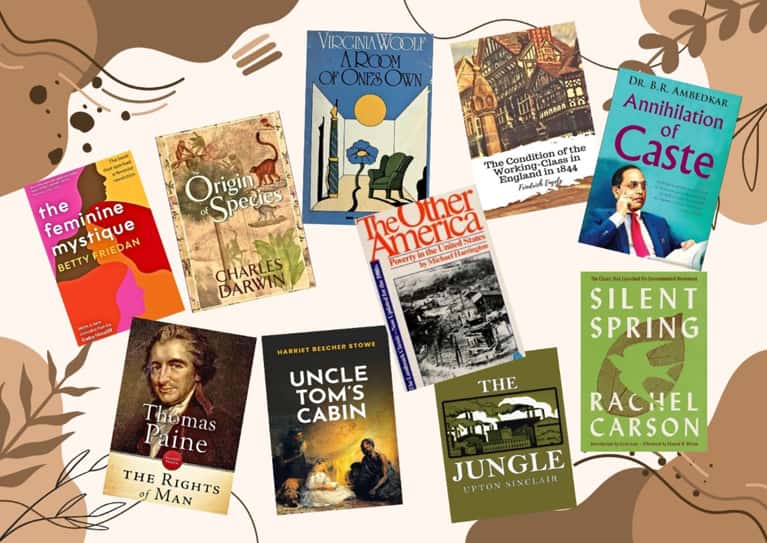
10 Powerful Books That Changed Social Policies and Shaped the World
Books have the power to do far more than tell stories. Some expose injustices, challenge social norms, and inspire reforms that shape laws, institutions, and public opinion. Throughout history, certain books have sparked conversations that led to real-world change, proving that ideas can transform societies.
1. The Origin of Species by Charles Darwin. Published in 1859, Darwin’s groundbreaking work introduced the theory of evolution by natural selection. The book revolutionised the scientific understanding of life and challenged long-held religious and social assumptions. Its influence extended beyond science, shaping educational curricula and public discourse worldwide. Few books have altered humanity’s perception of itself as profoundly as this one.
2. A Room of One’s Own by Virginia Woolf. In this extended essay, Woolf argued that women need financial independence and intellectual freedom to create and thrive. The book highlighted the barriers women faced in education and literature, becoming a foundational text in feminist thought. Its ideas encouraged discussions about gender equality, access to education, and women’s representation in public life. Nearly a century later, its message remains relevant.
3. The Condition of the Working Class in England by Friedrich Engels. Drawing on firsthand observations, Engels documented the harsh realities of industrial-era labourers. He exposed poor housing, dangerous working conditions, and widespread poverty among workers. The book brought attention to social inequalities created by rapid industrialisation and influenced labour reform movements. It remains an important work in discussions about workers’ rights and social justice.
4. The Feminine Mystique by Betty Friedan. Published in 1963, this influential book challenged the notion that women could find fulfilment solely through domestic life. Friedan explored the frustrations experienced by many women whose ambitions extended beyond traditional expectations. The book became a catalyst for the second-wave feminist movement and influenced debates surrounding workplace equality, education, and reproductive rights. Its impact was felt across many countries.
5. The Rights of Man by Thomas Paine. Written in defence of the ideals of the French Revolution, Paine’s work championed democracy, individual liberty, and social welfare. He argued that governments should serve the people and support those in need through public programmes. The book helped popularise democratic principles and inspired political reformers across Europe and the Americas. Many of its ideas continue to resonate in modern democracies.
6. Uncle Tom’s Cabin by Harriet Beecher Stowe. This novel exposed the brutality and human cost of slavery in the United States. Through its emotional storytelling, it brought the realities of enslavement into the homes of readers who had never witnessed it firsthand. The book strengthened anti-slavery sentiment and became a powerful cultural force in the years leading up to the American Civil War. Its impact demonstrated how fiction can influence public opinion.
7. The Jungle by Upton Sinclair. Although intended as a critique of labour exploitation, Sinclair’s novel shocked readers with its descriptions of unsanitary practices in the meatpacking industry. Public outrage following its publication led to significant food safety reforms and stricter government oversight. The book directly contributed to legislation aimed at protecting consumers. It remains one of the most cited examples of literature influencing public policy.
8. The Other America by Michael Harrington. Published in 1962, this book revealed the extent of poverty hidden beneath the surface of post-war American prosperity. Harrington documented the struggles of millions who were excluded from economic growth and public attention. The work played a major role in shaping discussions about poverty and social welfare. It is often credited with influencing anti-poverty initiatives introduced during the 1960s.
9. Silent Spring by Rachel Carson. Rachel Carson’s landmark work exposed the environmental dangers posed by widespread pesticide use, particularly DDT. Combining scientific evidence with accessible writing, she raised public awareness about ecological damage and health risks. The book sparked the modern environmental movement and led to greater environmental regulation in many countries. Its influence can still be seen in conservation policies today.
10. Annihilation of Caste by B. R. Ambedkar. Originally written as a speech, this powerful text challenged the caste system and called for radical social reform in India. Ambedkar argued that true equality could not exist while caste-based discrimination persisted. The book remains one of the most influential critiques of social hierarchy and injustice. Its ideas continue to shape conversations about equality, human rights, and constitutional values.
The books on this list differ in genre, subject, and historical context, but they share one important characteristic: they changed the way people think. By exposing social problems, questioning accepted norms, and proposing new ideas, they helped shape policies and influence generations. For aspiring authors, these works serve as a reminder that writing can leave a lasting legacy. Today, opportunities to publish and print your own book make it easier than ever to share ideas that inform, inspire, and perhaps even contribute to meaningful social change.